
Coir Netting for Slope Stabilisation in Railway Cuttings and Embankments
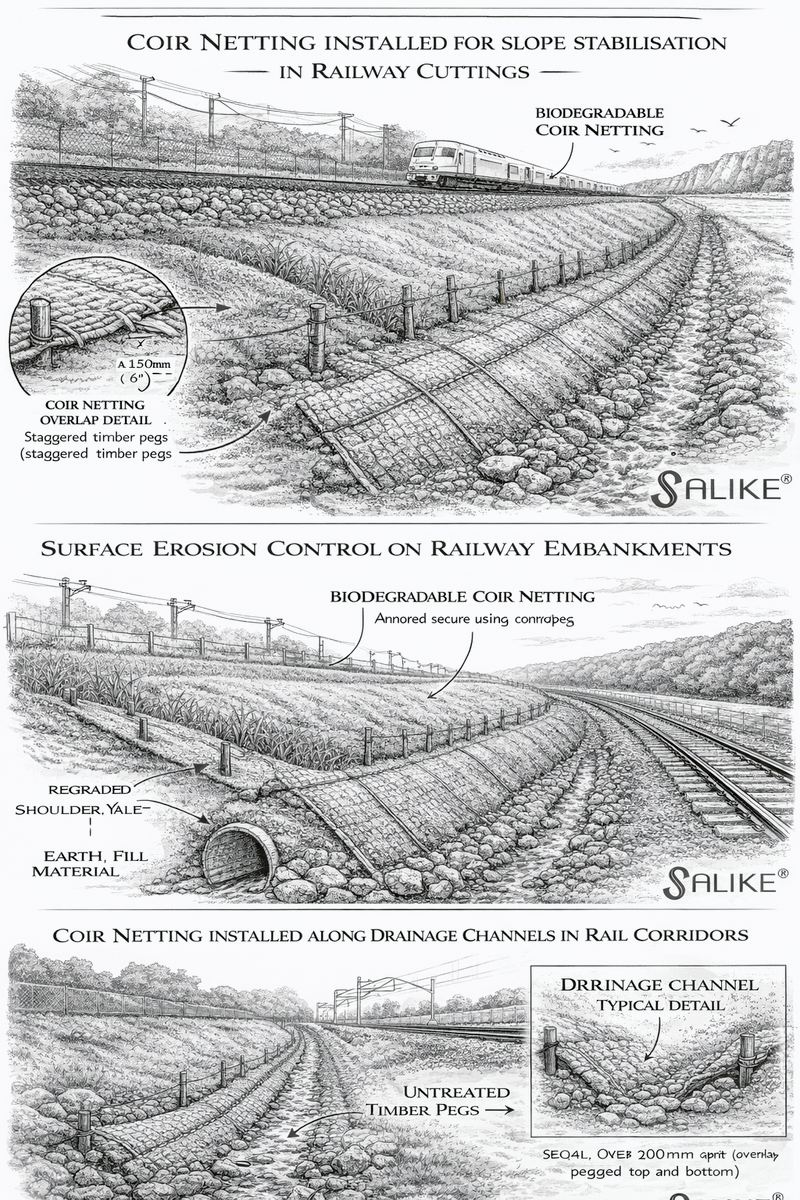
A Natural Fibre Engineering Approach to Surface Erosion Control in Rail Infrastructure
Railway earthworks represent some of the most scrutinised and maintenance-sensitive assets within the United Kingdom’s infrastructure portfolio. Cuttings and embankments are subject to continual weathering, cyclic saturation, vegetation stress and operational vibration. When surface erosion is left unmanaged, it can accelerate shallow instability, expose subgrade material and compromise long-term asset resilience.
At Salike®, we approach coir netting not as a landscaping accessory, but as a defined engineering component within slope stabilisation strategy — particularly suited to railway cutting slopes, embankment shoulders and transitional drainage zones where surface erosion control is required during vegetation establishment.
This article examines the technical role of high-density coir netting in railway environments, its performance envelope, and its suitability when compared with synthetic alternatives.
The Engineering Context: Railway Cuttings and Embankments
Railway slopes typically fall within gradients ranging from 1:1.5 to 1:3, often constructed historically from locally won materials. Over time, these slopes may exhibit:
- Surface wash during high rainfall events
- Rilling and gully formation
- Vegetation loss due to drought or maintenance clearance
- Progressive toe erosion
- Cyclic wetting and drying shrinkage in cohesive soils
While deep-seated instability demands geotechnical intervention, many railway earthwork failures initiate as surface erosion phenomena. It is therefore prudent to treat the upper soil horizon before erosion mechanisms advance.
Surface stabilisation, properly specified, is preventative engineering.
The Role of Coir Netting in Railway Slope Stabilisation
High-density coir netting (typically 700gsm, 2mX 50m or 4m X50m rolls configuration) provides:
- Surface erosion control
- Soil particle retention
- Hydraulic velocity reduction at the soil interface
- Anchorage for seeded or hydroseeded vegetation
- Temporary tensile restraint during establishment phase
The open-weave structure allows rainfall to infiltrate naturally while limiting displacement of fine particles. Unlike impermeable coverings, coir netting does not trap water against the slope surface — a critical factor in railway embankments where pore water pressures must remain controlled.
Properly installed, coir netting:
- Conforms to slope geometry
- Is pinned using biodegradable or galvanised fixing pins
- Interfaces cleanly with crest and toe drainage features
- Remains stable until vegetation root systems assume structural responsibility
The objective is transitional reinforcement — not permanent structural retention.
Hydraulic and Geotechnical Performance Considerations
In railway environments, design considerations should include:
- Rainfall intensity and design storm return period
- Soil classification (cohesive vs granular)
- Shear strength parameters of upper soil horizon
- Slope angle and length
- Drainage condition
- Vegetation establishment programme
Coir netting primarily addresses shallow surface erosion and is most effective where:
- Slopes are less than 45°
- Failure mechanisms are superficial
- Drainage is functional
- Vegetation establishment is integrated into the design
It is not intended to replace soil nails, geogrids or structural retaining systems in deep instability scenarios.
Engineering judgement remains paramount.
Comparison with Synthetic Erosion Control Systems
Synthetic meshes and geotextiles are commonly specified within rail corridors. However, they introduce several considerations:
- Long-term persistence beyond functional requirement
- Potential entanglement risk for maintenance operations
- Increased embodied carbon
- Removal complexity at end of lifecycle
By contrast, coir netting:
- Biodegrades within a defined period aligned to vegetation maturity
- Integrates into soil profile over time
- Eliminates long-term retrieval requirement
- Supports biodiversity objectives increasingly embedded in rail asset management
From a whole-life assessment perspective, natural fibre systems offer compelling advantages where structural permanence is unnecessary.
Installation in Railway Corridors
Installation within operational rail environments demands coordination with:
- Possession planning
- Access constraints
- Safety compliance
- Asset protection requirements
Best practice includes:
- Surface preparation and regrading prior to laying
- Secure anchoring at crest and toe
- Overlapping joints to prevent weak lines
- Integration with hydroseeding or live planting
- Inspection following first significant rainfall event
Attention to detailing determines performance.
Vegetation Integration and Long-Term Resilience
The performance of coir netting is intrinsically linked to vegetation establishment. Species selection should reflect:
- Local soil conditions
- Exposure and shading
- Maintenance access requirements
- Root depth and density
As root systems develop, they interlock with the coir matrix, increasing surface shear resistance and binding soil particles. The fibre gradually degrades as biological reinforcement strengthens.
This staged transition from mechanical restraint to biological stabilisation is central to natural fibre engineering.
Application Areas within Railway Infrastructure
Coir netting is particularly suitable for:
- Newly reprofiled cutting slopes
- Embankment shoulders adjacent to track
- Drainage channel side slopes
- Bridge abutment transitions
- Maintenance regrading works
- Temporary works following slip remediation
It is less appropriate in:
- Highly exposed rock faces
- Slopes exceeding design gradient limits
- Sites with active deep rotational movement
Specification must align with site reality.
Salike® Engineering Position
At Salike®, we supply engineered coir netting manufactured to consistent density and weave standards suitable for infrastructure applications.
We do not promote universal solutions. We promote correct application.
Our approach emphasises:
- Defined performance envelope
- Transparent material specification
- Compatibility with railway environmental obligations
- Alignment with sustainable asset management objectives
Slope stabilisation in railway environments demands durability, predictability and responsible lifecycle planning. Natural fibre systems, when properly specified and installed, meet those requirements within their intended scope.
Conclusion: Responsible Surface Stabilisation for Rail Infrastructure
Railway cuttings and embankments require continual stewardship. Surface erosion, if unchecked, becomes structural risk.
High-density coir netting provides a technically credible method of:
- Reducing rainfall-induced erosion
- Supporting vegetation establishment
- Enhancing slope resilience
- Minimising long-term environmental footprint
In the appropriate geotechnical context, it represents disciplined, proportionate engineering.
For rail engineers, principal contractors and asset managers seeking sustainable slope stabilisation solutions, natural fibre netting warrants serious technical consideration — not as a substitute for structural design, but as an integral component of surface erosion management strategy.