
Few phrases in health and safety are as powerful, recognisable or controversial as 'Zero Harm'.
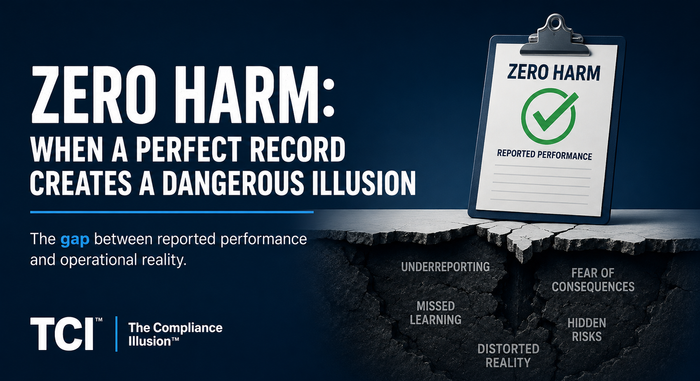
For some, it represents an unwavering commitment to protecting people: a clear statement that harm is unacceptable and that organisations should never become comfortable with injury and for others, it has become associated with unrealistic expectations, distorted reporting and a culture where maintaining the appearance of safety can become more important than understanding what is actually happening.
Through the lens of The Compliance Illusion™, maybe the real issue is not Zero Harm itself, maybe it is what can happen when the reported picture of safety begins to diverge from operational reality.
When Zero Harm Becomes Part of the Illusion
At its best, Zero Harm is an aspiration and at its worst, it becomes a scorecard.
The moment maintaining a perfect record becomes a measure of success, people begin to understand what leadership values. If reporting an injury, near miss, mistake or unsafe condition could damage a team's performance, a manager's reputation or an organisation's record, behaviour can begin to change.
Not necessarily because the organisation has become safer but because the organisation has become quieter.
Minor injuries become 'not worth mentioning'. Near misses remain informal conversations. Concerns go unchallenged, information that could challenge the positive picture becomes less likely to travel upwards and this is where the The Compliance Illusion™ begins to emerge. The organisation sees reassuring data and interprets it as evidence of safety but the data may simply be telling leaders what the system is able or willing to report.
The numbers improve and leadership confidence increases but operational understanding may actually be declining.
The Understanding Gap Behind the Numbers
A low incident rate is useful information but it is not necessarily proof that risk is being effectively controlled.
This is one of the fundamental challenges for organisations. Leaders naturally use reported data to form a view of performance but reported performance and actual performance are not necessarily the same thing.
A perfect safety record may represent an effective, well controlled organisation or it may represent underreporting and the number alone cannot tell you which.
That is the Understanding Gap™. The gap between what leadership believes it knows and what is actually understood about conditions on the ground. The problem begins when positive data creates confidence without sufficient challenge, verification or independent assurance.
When People Learn to Protect the Picture
Most organisations would never intentionally create a culture where people are reluctant to report concerns but cultures are shaped by incentives, expectations and consequences.
If reporting creates learning, people are more likely to report. If on the other hand reporting creates blame, embarrassment or consequences for the person, team or manager, people may adapt accordingly.
A workforce that feels psychologically safe will tell you where the problems are, whereas a workforce that feels pressure to maintain a perfect record may tell you what it believes leadership wants to hear.
Both can produce reassuring reports but only one produces genuine understanding. This is why organisations should be cautious about celebrating low numbers without asking more difficult questions:
What might we not be seeing?
What would cause someone not to report this?
Do our positive indicators reflect effective control, or simply effective reporting processes?
How do we independently test whether our understanding matches operational reality?
These are assurance questions and they are often more valuable than the headline number.
Optics Versus Operational Reality
The safest organisations are not necessarily those that report the fewest problems. They may be the organisations that are best at discovering problems early.
Learning requires visibility, visibility requires honesty and honesty requires trust.
If maintaining a perfect record becomes more important than understanding reality, an organisation can inadvertently create the very conditions in which The Compliance Illusion™ thrives.
The reported picture looks positive. the dashboard reassures, leadership believes controls are effective but the operational reality may be more complex.
The danger is not simply that incidents are underreported, it is that leadership begins making decisions based on incomplete or distorted information while remaining increasingly confident in the conclusions being draw and that is where the gap becomes most dangerous. Not when nobody knows there is a problem but when the organisation believes it knows more than it actually does.
Does the Pursuit of Perfection Distort Behaviour?
There is nothing wrong with striving to prevent harm. Organisations should aim for the highest possible standards of care, control and protection but there is a difference between pursuing an aspiration and demanding a particular outcome.
When perfection becomes the expectation, people can begin to focus on protecting the target rather than improving the system. One encourages curiosity and the other can encourage defensiveness. One asks, What can we learn? and the other asks, How do we explain this?
And once that shift happens, the organisation risks becoming increasingly confident in the story it tells itself.
So Should We Abandon Zero Harm?
Not necessarily.
The aspiration behind Zero Harm is difficult to argue against. Nobody wants harm to be normalised or accepted as inevitable but organisations need to be clearer about what Zero Harm is for.
As a guiding principle, it can encourage vigilance, care and continuous improvement but as a performance scorecard, it can create pressure to preserve the appearance of success.
The real question should be How confident are we that the picture we are seeing reflects and not, have we achieved Zero Harm? Because organisations do not become safer by knowing less, they do not improve simply because the numbers look better and positive reports should never remove the need for curiosity. That is the challenge at the heart of The Compliance Illusion™:
When confidence is greater than understanding, the organisation may look safer than it really is.
Discussion
Does Zero Harm inspire excellence or can the pursuit of a perfect record unintentionally widen the gap between reported performance and operational reality?
Perhaps the real question is not whether Zero Harm has a place in modern safety culture, it is whether leaders have sufficient assurance that their confidence is based on reality rather than a reassuring story.